A brief review on Nanoparticles: Type of platforms, biological synthesis & evaluation
Abstract
Nanoparticles are represents as particulate dispersions or solid particles with a size in the range of 10-1000nm. The nanoparticles have been used to transform the physical approach and enhance the pharmacokinetic and pharmacodynamic properties of many types of drug molecules. They have significant advantage in conventional drug delivery in form of high specificity, high stability, high drug carrying capacity, control release ability, possibility occur to different rout of administration and having a capability to deliver hydrophobic and hydrophilic drug molecules. This review focuses on type, preparation and evaluation of nanoparticles.
Keywords
Nanoparticles, type, application, evaluation
Introduction
Nanoparticles contains sub-sized colloidal structure ranging from 10-1000nm and are compared with semi-synthetic and synthetic polymers 1. The nanoparticles are microscopic material which contains less than 100nm 2. Due to their large surface area nanoparticles have distinctive size dependent properties 3. Nanoparticles have been actively search as drug delivery system for small drug molecules such as macromolecules –proteins, peptides, nucleic acid and hormones. The macromolecules such as protein and peptide have stability problem when administer orally, this problem is prevented by making nanoparticles. Further this was completed that the nanoparticles contains bioactive could not deliver drug in the specific organs but delivery of addition could be controlled 4. The nanoparticles have also been used in vivo to protect the entity of systemic circulation, prevent access of drug to selected site and to deliver the drug at a sustained and controlled rate of site of action. The various type of polymer are used in preparation of nanoparticles drug delivery research to increase the therapeutic benefit and minimizing the side effect 5.
In addition, greater density of therapeutic drug can also be dispersed, encapsulated of dissolved in nanoparticles, which it depends upon the preparation process to lies different properties and release characteristics of the entrapped agent. Though liposomes are used as potential carrier with properties including protecting drug from degradation, reduction in toxicity or side effect and targeting to site of action. Despite this versatility, some technical limitations including poor reproducibility and stability have been reported6. The new feature of nanoparticles are low concentration of excipient are used in formulation ,simple procedure for preparation ,great physical stability and sustained release of drug possible that may be used in chronic disease. Further, the nanoparticles are used in various route of administration such as oral, nasal, parenteral and opthalamic 7.
Advantages of nanoparticles
-
Nanoparticles lies dimensions below the critical wavelength renders to them transparent, a properties increases which makes the application of packaging, cosmetics and coatings.
-
The particles size and surface characteristics of nanoparticles can be easily controlled achieved both active and passive targeting.
-
The release of drug can be controlled or sustained so as to enhance therapeutics efficacy of drug and reduce side effects.
-
They can be stored for long time for 1 year so it has longer self stability.
-
They have the ability to mix both hydrophobic and hydrophilic drugs molecule.
-
They have higher carrier capacity and drug can be mixed without any chemical reaction and hence preserving the drug activity.
-
The drugs can be administered different routes of administration such as oral, parenteral, nasal, etc.
-
These have to capability to enhance the bioavailability of drugs.
-
They have longer clearance time.
-
Site-specific targeting can be achieved by attaching targeting ligands to by using magnetic guidance and surface of particles.
Disadvantages of nanoparticles
-
It includes the higher manufacturing cost which may lead to increase cost of formulation.
-
They have very low encapsulation efficiency.
-
Water soluble drugs can be rapidly circulate in the presence of blood components.
-
They have small size and large surface area can lead to particle-particle aggregation, making physical handling of nanoparticles difficult in liquid and dry forms.
-
They may activate immune response and allergic reaction.
-
It may involves use of harsh toxic solvents in the preparation process 8.
Synthesis of Nanoparticles
Nanoparticles may be synthesized by biological and chemical. So many adverse effects have been reported during chemical synthesis methods due to the presence of some toxic chemical absorbed on the surface. Eco friendly alternatives to Chemical and physical methods are Biological ways of nanoparticles synthesis using microorganisms9, 10 enzymes 11, fungus 12, and plants or plant extracts13, 14.
Biological synthesis of nanoparticles by Fungi
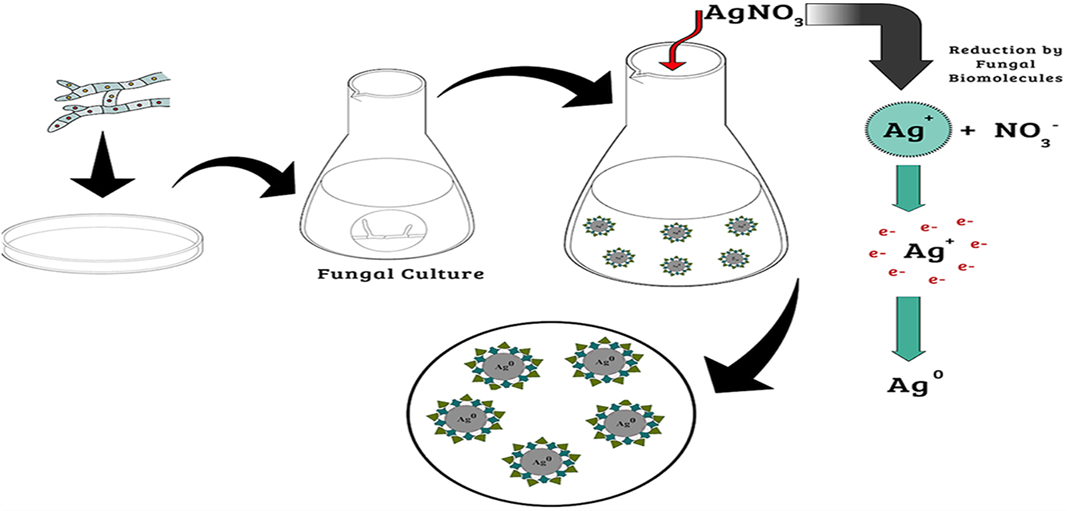
Fungi contains proteins and enzymes, which have the capacity to reduce the metals ions into
nanoparticles and then behave as nanoparticles. Fungi produces large amount of proteins, because the conversion of metal salts into metal nanoparticles is very fast. A. fumigates15 and phoma16 sps are used in synthesis of silver nanoparticles. Polydispersed silver nanoparticles are synthesized by the fungus Trichoderma viridea at 27°C which show the absorption band at 420 nm in UV visible spectrum 17. Gold nanoparticles are synthesized by in presens of the fungus Cylindrocladium floridanum. This was noted that 7 days, the fungi accumulated, the fungi accumulated face-centered cubic (FCC) (111)-oriented crystalline gold nanoparticles on the surface of the mycelia 18. The gold nanoparticles are synthesized by Aspergillus niger which is confirmed by their adsorption band which appears on 530 nm 19. It has been reported that Schizosaccharomyces pombe and Candida glabrata can reduce cadmium salt into CdS nanoparticles in solution 20.
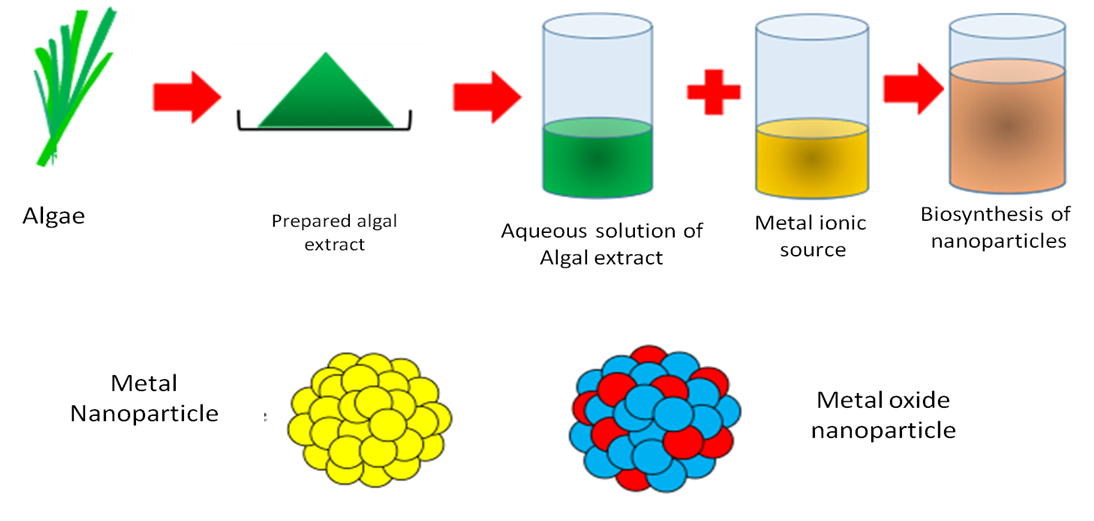
Synthesis of nanoparticles from Algae:
In case of algae the polysaccharide are reduce and stabilize the metal nanoparticles. The stabilization provided by polysaccharides relies on the presence of multiple binding sites along the polysaccharide chain to facilitate attachment to the metals surface, thereby effectively trapping the metal nanoparticle and conferring significant protection against aggregation and chemical modification. The silver nanoparticles are synthesized by different polysachharide e.g. Starch 21, 22, chitoson 23, natural gum 24, 25, marine polysaccharides 26, and hyaluronan 27. Gold, silver and Au/Ag bimetallic nanoparticles can be synthesized by Spirulina platensis 28.
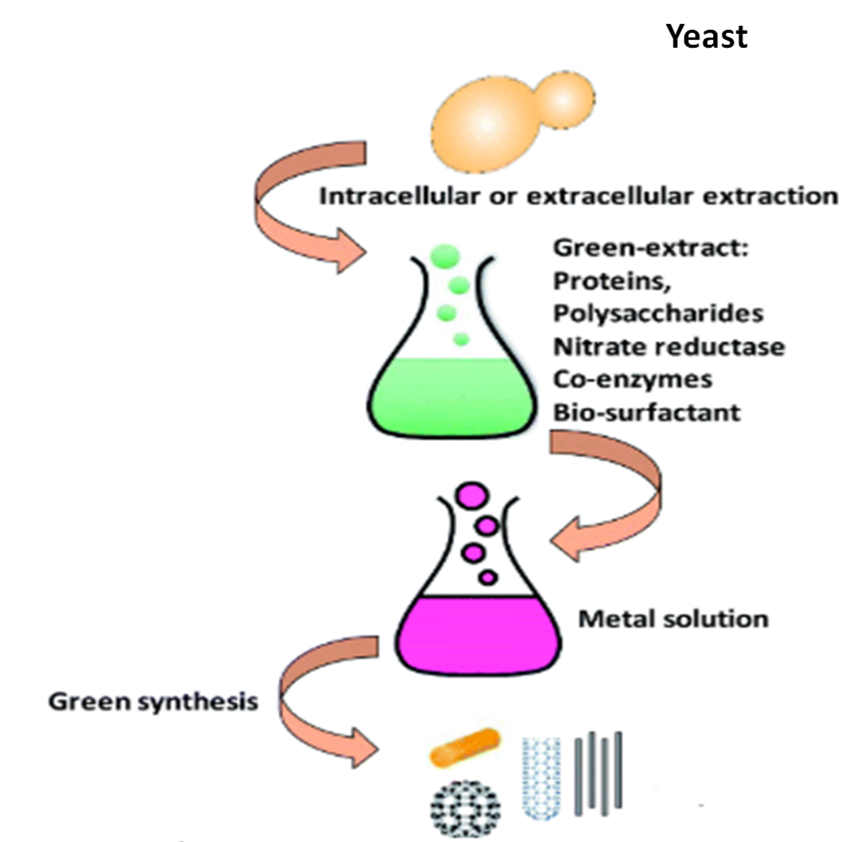
Synthesis of Nanoparticles from Yeast
Yeast strains contains more benefits over the bacteria because of their mass production of nanoparticles and very easy to control laboratory circumstances, the synthesis various enzymes and rapid growth of with the use of simple nutrients 29. Some research have been assist to investigate the synthesis of metallic nanoparticles using the yeast. However, for this purpose, the using the eukaryotic systems, namely, Candida glabrata and S. pombe, one of the primary methods in employing biological material was attained 30. The possible applicability of nanoparticles synthesized by yeast have been shown by few investigations. In the case of fabrication of diode cadmium and intracellular synthesized sulfide nanoparticles by S. pombe, which had low-voltage operation and high forward current value. It is assumed that the these properties can form the artificial structure of a perfect diode.
Synthesis of nanoparticles from Bacteria:
The bacteria have an ability to reduce heavy metals ions and one of the best candidates of synthesis of nanoparticles. The ferric ion is reduced to ferrous by Thiobacillus ferrooxidans, T. thiooxidans, and Sulfolobus acidocaldarius when growing on elemental sulfure as energy source 31. The pure gold nanoparticles are produced by the bacterium Delftia acidovoransin, which the production of a small non-ribosomal peptide, delftibactin were responsible for producing the gold nanoparticles 32. The extracellular formation of gold nanoparticles is synthesized by the bacterium Rhodo Pseudomonas capsulate. The gold nanoparticles were synthesized by an NADH-Dependent Reductase 33. It was demonstrated that bacteria found in Alpine sites have the capacity to produce zero valent palladium nanoparticles. It was reported that pseudomonas cells were invalve in producing active catalytical nanoparticles 34. It was reported that Morganella morganii synthesizes the copper nanoparticles intracellularly by uptake of the Cu ions and subsequent binding of the ions to either a metal ion reductase or similar protein. This causes the reduction of the metallic ion to metallic CuO which then accumulates extracellularly as nanoparticles once effluxed out of the cell 35.
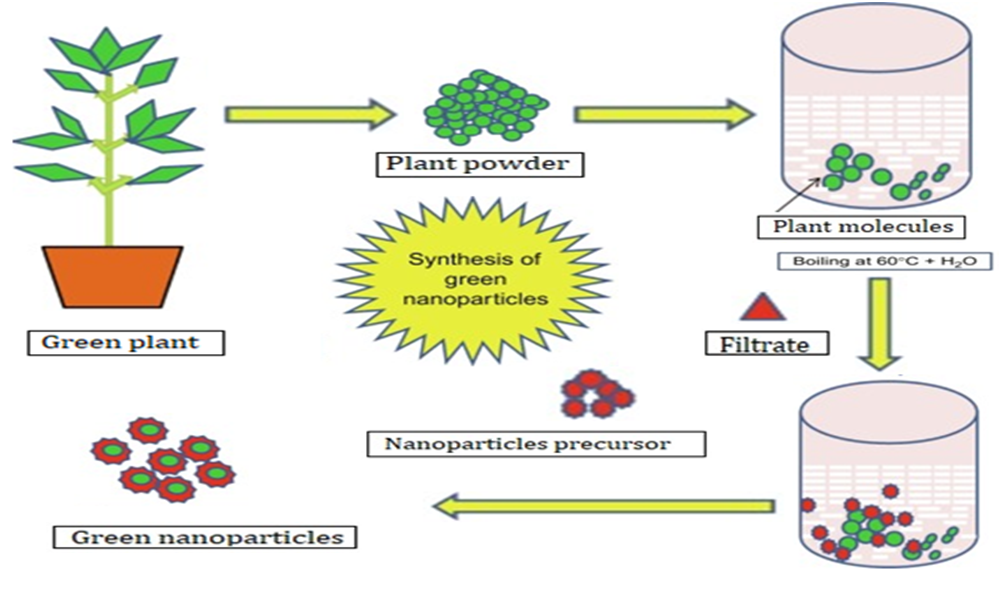
Synthesis of nanoparticle from Plants
The synthesis of nanoparticles by plants are very usefull because it produces large number of nanoparticles. The stabilizing and reducing agent are present in plant by nature. It is stated that polymorphic gold nanoparticles can be synthesized from Citrus limon, Murraya koenigii Linn. Leaves, and Quisqualis indica pink, Canna indica (red) owers. These nanoparticles were stable and 10-130 nm in sized 36. Gold and silver nanoparticles are synthesized by Lonicera japonica plant leaf extract. In these the silver is 36-72 nm and having spherical to plate like poly-shaped , gold nanoparticles synthesized were poly-shaped nanoplates and having size 40-92 nm. The carbohydrate, polyphenol, protein are responsible for reduction of metal ion into nanoparticles 37.
Type of nanoparticles
-
Silver :- Silver nanoparticles are most effective because it has antimicrobial efficacy against bacteria, viruses and other eukaryotic micro-organisms 38, 39. They are most widely used nanomatials as antimicrobial agent, in textile industries, for water treatment, sunscreen lotion etc 40, 41. The studies have been reported that the silver nanoparticles is synthesized Azadirachta indica, Capsicum annuum and Carica papaya.
-
Gold :- Gold nanoparticle are used in immunochemical studies for identification of protein interaction. They are used as lab tracer in DNA fingerprinting to detect DNA in sample. They are also used in aminoglycosides antibiotics such as neomycine, gentamycine and streptomycine. Gold nanorods are used in detection of cancer stem cells, which are beneficial for diagnosis of cancer, and identification of different type antibiotics 42, 43.
-
Alloy :- Alloy nanoparticles contains structural properties that are different from their bulk samples. Since Ag has highest electrical conductivity among metal fillers and, unlike many other metal, their oxides contains relatively better conductivity, Ag flaxes are most widely used 44.
-
Magnetic:- Magnetic nanoparticles such as Fe3O4(magnetite) and Fe2O4(maghamite) are known to be biocompatible. They have been investigated for stem cell sorting and manipulation, targeted cancer treatment, guided drug delivery, gene therapy, DNA analysis, and magnetic resonance imaging 45.
Application
Nanoparticles has tremendous prospects for the improvement of diagnosis and treatment of human disease. Uses of microbes in biosynthesis of nanoparticles is an environmentally sustainable procedure. Nanotechnology has revolutionize a wide array of tools in biotechnology so that they are more personalized, portable, cheaper, safer, and easier to administer 46.
Evaluation
Percentage yield
Percentage practical yield is required for know about the efficiency of any method, which helps in selection of appropriate method of production. Practical yield is calculated by weight of nanoparticles recovered from each batch in relation to the sum of starting material. The percentage yield is determind by following formula.
Drug entrapment efficiency
The entrapment efficiencies of prepared systems were determined by measuring the concentration of free drug in the dispersion medium. The obtained suspension was centrifuged for 60 min at 10,000 rpm. The supernatant was separated and then filtered through 0.45 μm Millipore (Millipore Filter). The filtrate was diluted using 75% ethanol and measured spectrophotometrically (Shimadzu, UV 1700, Japan) at 292 nm. The amount of free drug was detected in the filtrate and the amount of incorporated drug was determined as a result of the initial drug minus the free drug. The entrapment efficiency is calculated by using the following equation.
Where: W initial drug= the mass of initial drug used.
Particle size characterization
Particle size analysis
In order to analyze particle size drug loaded nanoparticles were dispersed in deionized water, vortexed for 10 min before sampling. Particle size was determined by laser scattering light using Malvern Laser Analyzer Instruments 47.
Zeta potential
Zeta potential is a symble for electrokinetic potential in colloidal systems. Zeta potential is electric potential in the interfacial Double Layer (DL) at the location of the slipping plane versus a point in the bulk fluid away from the interface 48. Zeta potential is not measured directly but it can be calculated using theoretical models and an experimentally dynamic electrophoretic mobility or determined electrophoretic mobility. This velocity can be determined by measuring the dropper shift of laser light scattered off the moving particles. The surface charge was determined by measuring the electrophoretic mobility of the nanoparticles using a Malvern zeta sizer. Samples were prepared by diluting with distilled water 49.
Polydispersity index
Polydispersity index is define the particle size distribution of nanoparticles obtained from photon correlation spectroscopic analysis. It is a dimensionless number predicted from the autocorrelation function and range from a value of 0.01 for mono dispersed particles and up to value of 0.5 – 0.7. Sample with very broad size distribution have polydispersity index value >0.7.
Shape and Surface morphology
Shape and surface morphology of nanoparticles was done by Scanning Electron Microscopy. SEM has been used to determine surface topography, texture and to examine the morphology of fractured surface. Small volume of nanoparticulate suspension was placed on an electron microscope brass stub. The stubs were placed briefly in a drier and then coated with gold in an ion sputter.
Conclusion
It can be concluded that the biological synthesis of nanoparticle are synthesized by Cylindrocladium floridanum fungus, Algae, bacteria and plants. It can be also concluded that various type of nanoparticles like gold, silver, alloy etc. have also studies about the various method of evaluation like zeta potential, Percentage yield, Shape and Surface morphology, particle size analysis etc.