Perilous HIV brings out deadly cancers
Abstract
Human Immunodeficiency Virus (HIV) infection is both infectious and contagious disease. The people infected with HIV have an increased risk of cancer while comparing with uninfected people. Kaposi’s sarcoma, aggressive B-cell Non-Hodgkin Lymphoma & cervical cancer are the three types of cancers which are termed as “HIV –associated cancers”. Apart from these cancers, HIV patients are prone to cancers of anus, liver, lung, pharynx which are termed as “non-AIDS defining cancers”. Viral oncogenesis and cytokine induced growth contribute to the development of Kaposi sarcoma. Several virally encoded genes such as bcl-2, IL-6, cyclin-D, GPCR & interferon regulatory factor, plays key role in cellular proliferation and survival. Infection with HIV weakens the immune system and reduces the body’s ability to fight against viral infections that may lead to cancer. Immunosuppression and inflammation in HIV patients also contribute to cancer progression. The complications of AIDS- related cancers include easy bleeding and bruising, tiredness, nausea, vomiting, poor appetite, mouth sores, hair loss etc. According to the data, HIV infected males are more susceptible to Kaposi’s sarcoma and Non- Hodgkin Lymphoma whereas females are more liable to cervical cancers. Early diagnosis and treatment options help to drop the risk of AIDS related cancers. The HAART therapy reduces the risk of cancer in HIV patients by lowering the amount of HIV circulating in blood, so that function of immune system to fight against the virus can be restored. Other treatment methods are chemotherapy, immunotherapy, radiation and surgery.
Keywords
HIV, HIV-associated cancers, Kaposi sarcoma, cyclin-D, Immunosuppression, HAART
Introduction
Human Immunodeficiency Virus (HIV) is a retrovirus, which uses the RNA as its genetic material, after infecting a cell, uses the enzyme reverse transcriptase to convert its RNA to DNA. It is the virus that causes Acquired Immunodeficiency Syndrome (AIDS), which is the most advanced stage of HIV infection. HIV occurs as two types: HIV-1 &HIV-2. AIDS is a disease in which there is a severe loss of the body’s cellular immunity, greatly lowering the resistance to infection and malignancy. The transmission of HIV virus can be via the infected blood, or body fluids. Cancer is a condition in which there is an uncontrolled growth of cells or tissues in the body. Therefore, HIV infection is been correlated with cancer in humans. A type of cancer that is more likely to occur in people who are infected with HIV is known as “AIDS-related cancers”. However, the spectrum of cancer types observed in excess HIV infected individuals was subsequently broadened to encompass a number of “Non-AIDS Defining Malignancies" (NADM) 1. An individual with HIV is highly vulnerable to the life threatening condition as this virus is weakening body’s immune system. Thereby the patient becomes prone to serious disease conditions like cancer. The HIV-related cancers are mainly of three types: Kaposi’s sarcoma, Non-Hodgkin Lymphoma & Cervical cancer.
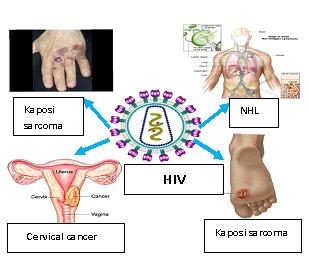
AIDS- Defining cancers
These types of cancers include the following:
Kaposi Sarcoma (KS): is a cancer which is developing from the cells that line lymph or blood vessels. KS causes lesions to grow in the skin, lymph nodes, internal organs and mucous membrane lining in the mouth, nose & throat. If often affects people with HIV/AIDS. In the past few decades, most KS cases in United States have been linked to HIV infection in homosexual men 2. These cancers are called epidemic KS. Kaposi sarcoma is caused by Human herpes virus 8 (HHV-8). The people with HIV when initially diagnosed will remain asymptomatic, especially when lesions are on skin 3 . But the other symptoms of KS include: unexplained fever, weight loss, swollen lymph nodes etc. Purple, red or brown skin blotches are the common sign in most cases of epidemic KS.
Non-Hodgkin Lymphoma (NHL): is a cancer which starts in the lymphatic system. This condition occurs when body produces too many abnormal lymphocytes, a type of WBC 2. Lymphoma begins when healthy cells in lymphatic system change and grow out of control, which may form tumour mass 2, 4. Lymphocytes are involved in fighting the germs in body. Lymph nodes and spleen frame out the parts of lymphatic system. Spleen is the organ that makes lymphocytes and filters the blood. The Epstein - Barr virus is linked with NHL. The common subtypes of NHL in HIV patients are: Aggressive B-cell Lymphoma, primary CNS lymphoma and primary effusion lymphoma 4. Symptoms of NHL include confusion, fatigue, facial paralysis and seizures 3.
Cervical cancer: is the cancer of cervix, which is strongly linked to infection caused by Human Papilloma Virus (HPV) which can spread through skin-skin contact 2 . Women with both HIV and HPV make the cervical cancer grow faster. Cervical Intraepithelial Neoplasia is condition in HIV infected women. It leads to abnormal growth of precancerous cells in the cervix which can overtime progress into invasive cervical cancer 4 . So, the cancer cells began growing into deeper layers of cervix which may worsen the condition.
People with HIV are also getting Non AIDS related cancers which include the following:
Lung cancer: Smoking is the major risk factor. The other mechanisms causing it include: 1) an oncogenic role of HIV infection itself 2) a direct consequence of HIV-related immunosuppression & decreased immune surveillance, similar to other ADMS 3) lung damage from recurrent infections, which are more common in HIV infected patients 4) an HIV mediated increase in susceptibility to tobacco carcinogens such as through increase in genomic instability 5, 6. Hodgkin Lymphoma, anal cancer, liver cancer are other NADM.
HIV- related cancer: Aetiological description
There are many reasons for AIDs Defining Malignancies (ADMs). Immunodeficiency is the main factor which leads to the HIV –related cancer. The decreased amount of CD4+ cells in HIV infected patients will have weaker immune system. Cancer is disease which can be caused by biological agents such as virus, bacteria, fungi etc. So, to prevent the uncontrolled growth of tissue in cancer, the body has to fight with virus invading the body. But, since HIV patient has weaker immunity they fail to fight against cancer causing pathogen, that is, reduced clearance and oncogenic virus infection & reduced immune surveillance of malignant cells. Studies state that both cumulative and current HIV RNA levels > 500 copies/ ml was independently associated with increased risk of ADM 1. HIV via tat & Vpr proteins may have direct pro-oncogenic effect 6. Synergism with other pro-oncogenic viruses, induction of tumour angiogenesis is the other factors causing ADM 7. Disruption of cell cycle regulation, blockage of tumour suppressor gene function, promotion of chromosome instability through inhibition of telomerase activity, impairment of DNA repair function and enhancement of effects of exogenous carcinogens are the other factors. Enhanced inflammation and coagulation has emerged as demonstrated by higher plasma levels of biomarkers, to cancer risk. The HIV medications such as cART therapy seems to enhance the chance of ADM related to its toxicity. Sometimes the HIV & other viruses work together to help the cancer cell to start growing, which can be rapid in patients with weakened immune system.
Epidemiology of AIDS-Defining malignancies
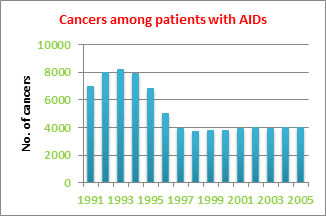
As the fig.2 shows that there is huge population prone to AIDS-Defining Cancers in the early 1991. It was the era when the Cart therapy was introduced. But coming to the years 2000-2005 there is a rapid increase in the NADM conditions.
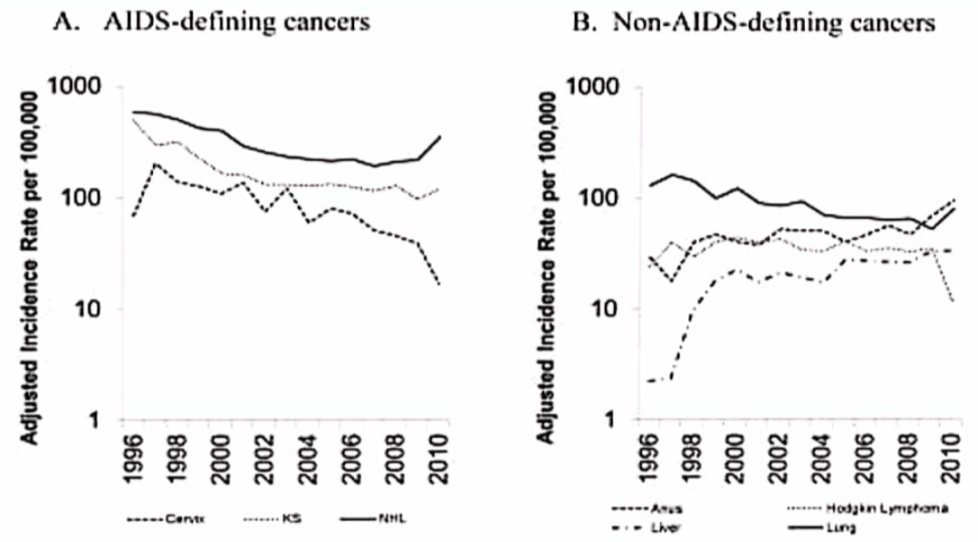
HIV infected individuals have a substantially elevated risk of developing KS, certain high grade NHLs & cervical cancers. In the US, during 1991-1995, HIV infected people had risk that were 2800 fold elevated for KS, 10 fold elevated for NHL and 3 fold elevated for cervical cancers compared with general population 9, 10. In developing countries during the pre-HAART era, lung cancer risk was 3-5 fold elevated in HIV infected individuals as in fig.2. The HAART therapy in 1996 changed clinical outlook for HIV infected patients. In sub-Saharan Africa, where a large proportion of HIV infected patients reside, KS & cervical cancer are among the most common cancer 11. The greater availability of HAART in recent years gradually leads to decrease in occurrence of ADM overtime. Anal cancer is on rise in HIV positive population. In the 1990’s the incidence of anal cancer was approximately one case per 100,000 people but by 2004 the number of cases increased to 30% 12. And the rate elevated to 79%-80%.
Diagnosis & treatment methods of ADM
There are various possible complications for AIDS related cancers depending on the type and stages of the cancer, as well as the treatment used. The complications include greater risk of infection, easy bleeding & bruising, tiredness, nausea, vomiting, diarrhoea, poor appetite, mouth sores, hair loss etc. The risk factors like family/genetic history, smoking can also lead to cancer. The following are the diagnostic methods for ADM: 1) Biopsy – is the removal of small amount of tissue for examination under the microscope. 2) Computed tomography (CT/CAT) scans take picture of inside of body. 3) Endoscopy can also be done by inserting a tube through mouth, down oesophagus & stomach 13. The KS has been diagnosed with bronchoscopy which is been similar to endoscopy, photography of skin is also been taken to observe the skin lesions (mapping). NHL can be diagnosed with Positron Emission Tomography (PET) or PET-CT scan. In this test small amount of radioactive sugar substance is injected into patient’s body which is been taken up by cells, that use most energy. Cancer cell tends to use energy actively. Magnetic Resonance Imaging (MRI) is other method used to measure tumour size using special dye called contrast medium given before scanning procedure. Lumbar puncture (spinal tap) is used to diagnose Burkitt lymphoma. There are several molecular & genetic testing which include: Cytogenetics, Fluorescent in-situ Hybridisation (FISH), flow cytometry, PCR etc. Cervical cancer can be determined by pelvic examination 13. Pap test & HPV typing are other test done to diagnose it by taking cells from cervix or vagina.
The antiretroviral treatment is the highly active therapy which is given to HIV/AIDS related cancers, it finds to decrease the chance of recurrent cancer 3, 14, 15. The HAART therapy has reduced the incidence and improved the survival of patients with Kaposi sarcoma and AIDs related NHL. The antiretroviral drugs such as integrase inhibitors (Dolutegravir, Elvitegravir, Raltigravir), NNRTIs (Nevirapine, Delavirdine, Efavirenz, Etravirine), NRTIs (Zidovudine, Lamivudine, Tenofovir, Abacavir), protease inhibitors (Atazinavir, Darunavir, Ritonavir, Lopinavir) etc. can be prescribed for the condition of ADMs. Antiretroviral therapy is the most important intervention in terms of preventing opportunistic infections in patients with Human Immunodeficiency Virus infection. There are certain systemic therapies to destroy cancer cells & is done by chemotherapy, immunotherapy and targeted therapy 13. Chemotherapy is the use of drug to kill cancer cells. Immunotherapy is designed to boost the body’s immunity 14. It is also called as biologic therapy which is considered as systemic therapy to destroy cancer cells of ADMs. It is designed to boost the body’s natural defence to fight the cancer. HPV vaccine is approved by FDA to prevent Cervical and Anal cancers. Hepatitis B vaccine prevents Hep B virus; the long-lasting infection with HBV can cause liver cancer. The targeted therapy is a treatment which targets the cancer specific genes, proteins, cell tissue environment that contribute to cancer growth & survival. Radiation therapy using high energy X-rays destroys cancer cells. Surgery, the removal of whole tumour, is another method. KS can be cured by two surgical procedures: Curettage and Electrodessication & Cryosurgery 13. Photodynamic therapy is also been used. Topical medications such as skin creams are also prescribed. There is an increased frequency of invasive anal cancer in HIV-seropositive men. Early treatment strategies in this patient group employed reduced dosages of chemotherapy or radiotherapy alone to reduce toxicity. Since 1989 we have used combined modality treatment consisting of chemotherapy 5-fluorouracil (5-FU) and mitomycin C, and concomitant radical radiotherapy to the pelvis (38–51 Gy in 20–30 fractions), with most patients receiving a perineal boost (10–18 Gy) 16.
The immuno-suppression will decrease the ability of body to mount an immune response against the proteins which are encoded by the oncogenic viruses and cellular tumour antigens.
The increased levels of pro-inflammatory cytokines like IL-6 can dysregulate the immune system that can contribute to B-cell Lymphoma and KS. The HIV tat gene protein which enhances the efficiency of viral transcription appears to be a growth factor for Kaposi Sarcoma 6. Longer exposure to uncontrolled plasma HIV RNA was associated with a higher risk of AIDs - related malignancies, regardless of CD4+counts. Enhanced inflammation and coagulation has emerged as demonstrated by higher plasma levels of biomarkers which can lead to AIDs related malignancies. The HIV medication such as cART therapy seems to enhance the chance of ADM related to its toxicity. Recent studies states that incomplete viral suppression during HAART was a stronger predictor for development of AIDs – related lymphomas.
Conclusion
The HIV infection is directly or indirectly associated with cancer. The cancer mortalities declined in era of HAART therapy. Improved cancer prevention and treatment specifically for KS & NHL would reduce the mortality rates among people with AIDS. Early diagnosis and treatment under standard guidelines is necessary for effective cure in AIDS-Defining Malignancies.
Abbreviations:
HIV — Human Immunodeficiency Virus, AIDs — Acquired Immuno Deficiency Syndrome, GPCR – G-protein Coupled Receptor, Bcl-2 — B-Cell Lymphoma -2 gene, KS- Kaposi Sarcoma, NHL – Non-Hodgkin Lymphoma, HHV-8 – Human Herpes Virus 8, HPV — Human Papilloma Virus, ADM – Aids Defining Malignancies, NADM – Non- Aids Defining Malignancies, HAART – Highly Active Antiretroviral Therapy, FISH – Fluorescent In Situ Hybridisation, Tat protein – Trans-Activator of Transcription
Conflict of Interest: there is no conflict of interest reported by the author.